Wechsler Memory Scale | Fifth Edition
WMS-5
The Wechsler Memory Scale® Fifth Edition (WMS®-5) is the most advanced psychometric measure of adult memory. It is an individually administered clinical instrument for assessing immediate, delayed, and recognition memory across auditory and visual perceptual modalities, as well as visual working memory. The WMS®-5 was codeveloped and co-normed with the WAIS®-5, expanding construct coverage, increasing flexibility, and allowing comparison of performance across the two tests.Now available- Publication date:
- September 2025
- Age range:
- 16:0 – 90:11
- Qualification level:
- C
- Completion time:
- Varies based on battery: Comprehensive Memory Assessment | Standard Form (60 minutes), Brief Memory Assessment | Short Form (25 minutes), Alternate Form (25 minutes)
- Administration:
- Paper or Q-interactive®
- Scoring options:
- Manual scoring or Q-global®
- Telepractice:
- Guidance on using this test in your telepractice

Overview
The WMS-5 enables clinicians to explore core aspects of memory in a highly flexible, yet comprehensive, manner within a larger evaluation battery. The WMS-5 shares a normative sample with the WAIS-5, further increasing the utility of these comprehensive assessments when used together.
Features and benefits
- Flexible administration options for increasingly comprehensive information.
- Mental Status Screener
- Immediate Memory Screener
- Brief Memory Assessment – Short Form
- Comprehensive Memory Assessment - Standard Form
- Alternate Form
- Updated content, to streamline administration.
- Expanded scores for in depth interpretation of performance.
- Codeveloped and co-normed with WAIS-5 to enhance score interpretation, increase flexibility, and allow comparison of IQ and memory abilities.
- Alternate form allows for retesting and monitoring of memory processes without repeated exposure to the same stimuli.
- Improved digital administration options to eliminate paper materials (Q-interactive) or to support tele-assessment when traditional on-site testing isn’t possible (Q-global).
Open the box
Get an overview of what you can expect from the recently released WMS®-5!
Watch as Clinical Psychologist, Lynsey Psimas PhD, gives us a video tour!
Explore Q-interactive
Get started!
Request a free trial, or contact the sales team.
The following resources are available for WMS-5.
Materials
- WMS-5 Brochure
- WMS-5 Technical Manual - Chapter 1
- WMS-5 Administration and Scoring Manual - Chapter 1
- WAIS-5 & WMS-5 Advanced Clinical Solutions (ACS) Brochure
- WMS-IV vs. WMS-5 Comparison Flyer
Sample Reports
- WMS-5 Sample Report
- WMS-5 Score Report with ACS Demographically Referenced Scores
- WAIS-5 & WMS-5 ACS Performance Validity Report
Videos
Blogs
Podcasts
Join Dr. John Harrison as he speaks with world-renowned experts advancing earlier diagnosis, better treatments, and the future of brain health.
Kits and Materials
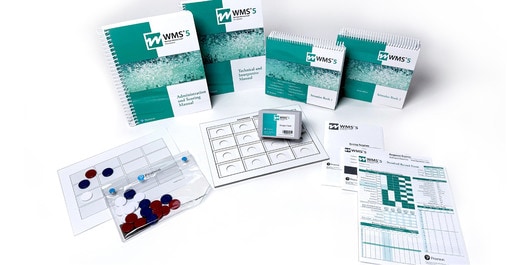
The WMS-5 Standard Kit provides all necessary components to administer the Standard Form of WMS-5, including the optional Brief Cognitive Status Exam. The WMS-5 Standard Kit is also available with an optional Q-global Scoring Subscription.
Short Form Record Forms are purchased separately if a brief memory assessment option is needed.
The Alternate Form Stimulus Book and Alternate Form Record Forms are purchased separately if a repeated measure is needed.The Standard Form is used for the most comprehensive memory assessment. The Standard Form contains all subtests (i.e., Logical Memory 1 & 2, Verbal Paired Associates 1 & 2, Visual Reproduction 1 & 2, Designs 1 & 2, Symbol Span, Spatial Addition) and the optional mental status screener, BCSE. An immediate memory screener can also be conducted using the Standard Form.
The Short Form is used for a briefer memory assessment. The Short Form contains Logical Memory 1 & 2, Visual Reproduction 1 & 2, and Symbol Span.
The Alternate Form, used for repeated administration, contains Logical Memory Alternate 1 & 2 and Visual Reproduction Alternate 1 & 2.No. The Standard, Short, and Alternate Record Forms are each used for the full age range.
No. The same Response Booklet is used for all Record Forms.
No. WAIS-5 kits and WMS-5 kits are sold separately.
A starter kit containing Response Booklets, and a Scoring Template is included with Q-interactive.
Test Structure and Scores
Subtest content was updated, and process and ancillary scores were added; no new subtests were added. Additionally, administration options were expanded, with 3 different forms, to offer increased flexibility and utility.
Yes.
Administration time depends on the form: Standard Form ~60 minutes, Short Form ~25 minutes, Alternate Form ~ 25 minutes (estimated administration times for the Short Form and Alternate Form do not include elapsed times between immediate and delayed recall conditions).
Yes, WMS-5 was co-developed and co-normed with WAIS-5 to maximize the utility of using the tests together.
Yes. Additional Index scores, Contrast scores, and Process scores for WMS that were available with Advanced Clinical Solutions (ACS) are now included in the WMS-5. Index scores reflecting single trial learning and multiple trial learning have also been added to the WMS-5.
Yes. Specific index scores from CVLT 3 can be substituted for VPA 1 & 2. CVLT-II scores cannot be used.
No.
Q-global is used to derive demographically referenced scores; scores are not available via hand scoring.
DRS reports are listed as a report option within the WAIS-5 and WMS-5 Q-global reporting function.
Enter the scores for the WAIS-5 and WMS-5 in Q-global along with the required demographics, and then select the following report options INSTEAD of the basic Score Report
- WAIS-5 Score Report with ACS Demographically Referenced Scores
- WMS-5 Score Report with ACS Demographically Referenced Scores
Yes. The WAIS-5 and WMS-5 score reports do not provide demographically referenced scores. The Score Report with ACS Demographically Referenced Scores includes the comprehensive score report followed by the demographically referenced score summary.
Related Items